Not affiliated with or endorsed by the FCC, NCVEC, ARRL or any VEC. Questions are the NCVEC pools word for word (public domain); explanations are our own. Exam rules and fees can change: check with your VE team.
T6A: Fixed and variable resistors; Capacitors; Inductors; Fuses; Switches; Batteries
Group T6A of the Technician pool (2026–2030) has 11 active questions. One of them is on every Technician exam. Each is shown word for word; open it to see the correct answer and our explanation.
T6A01
What electrical component opposes the flow of current in a DC circuit?
A Inductor
B Resistor
C Inverter
D Transformer
Show the answer and explanation
Correct answer: B. Resistor
Why B is right. B. Resistor.
A resistor is made to resist the flow of current. In a DC circuit, a bigger resistance means less current for the same voltage. The energy a resistor takes from the circuit becomes heat.
Why not A? An inductor mainly opposes changes in current; steady DC passes through its wire easily.
T6A02
What type of component is often used as an adjustable volume control?
A Fixed resistor
B Power resistor
C Potentiometer
D Transformer
Show the answer and explanation
Correct answer: C. Potentiometer
Why C is right. C. Potentiometer.
A potentiometer is a resistor with a sliding contact, called a wiper, that you move with a knob. Turning the knob changes how much of the signal reaches the next stage, which is how a volume knob works.
Why not A? A fixed resistor has one value and cannot be adjusted.
T6A03
What electrical parameter is controlled by a potentiometer?
A Inductance
B Resistance
C Capacitance
D Field strength
Show the answer and explanation
Correct answer: B. Resistance
Why B is right. B. Resistance.
A potentiometer is a strip of resistive material with a movable contact. Moving the contact changes how much of that strip sits between the terminals, so you are adjusting resistance.
Why not C? Changing capacitance needs a variable capacitor, which uses movable plates.
Remember: Pot = adjustable resistor.
T6A04
What electrical component stores energy in an electric field?
A Resistor
B Capacitor
C Inductor
D Diode
Show the answer and explanation
Correct answer: B. Capacitor
Why B is right. B. Capacitor.
A capacitor holds energy as an electric field between its plates. When voltage is applied, charge piles up on one plate and leaves the other, and the field between them stores the energy until it is released.
Why not C? An inductor stores energy in a magnetic field, not an electric one.
Remember: Capacitor: electric field. Inductor: magnetic field.
T6A05
What type of electrical component consists of conductive surfaces separated by an insulator?
A Resistor
B Potentiometer
C Oscillator
D Capacitor
Show the answer and explanation
Correct answer: D. Capacitor
Why D is right. D. Capacitor.
A capacitor is two conductive surfaces, such as metal plates or foil, kept apart by an insulator called the dielectric. Air, plastic film and ceramic are common dielectrics. The plates never touch, so steady DC cannot flow straight through.
Why not B? A potentiometer is a resistive strip with a sliding contact, not two separated plates.
T6A06
What type of electrical component stores energy in a magnetic field?
A Resistor
B Capacitor
C Inductor
D Diode
Show the answer and explanation
Correct answer: C. Inductor
Why C is right. C. Inductor.
Current flowing through a wire creates a magnetic field around it. An inductor, usually a coil, concentrates that field and stores energy in it. When the current tries to drop, the field gives energy back.
Why not B? A capacitor stores energy in an electric field between plates.
T6A07
What electrical component is typically constructed as a coil of wire?
A Transistor
B Capacitor
C Diode
D Inductor
Show the answer and explanation
Correct answer: D. Inductor
Why D is right. D. Inductor.
Winding wire into a coil makes the magnetic field from each turn add up, which increases inductance. That is why inductors are usually coils, sometimes wound on an iron or ferrite core.
Why not B? A capacitor is built from plates separated by an insulator, not a coil.
T6A08
What is the function of an SPDT switch?
A A single circuit is opened or closed
B Two circuits are opened or closed
C A single circuit is switched between one of two other circuits
D Two circuits are each switched between one of two other circuits
Show the answer and explanation
Correct answer: C. A single circuit is switched between one of two other circuits
Why C is right. C. A single circuit is switched between one of two other circuits.
SPDT means single-pole, double-throw. Pole is how many separate circuits the switch controls: one. Throw is how many positions each pole can connect to: two. So one input is routed to either of two outputs.
Why not D? Two circuits each switched two ways is a double-pole, double-throw (DPDT) switch.
T6A09
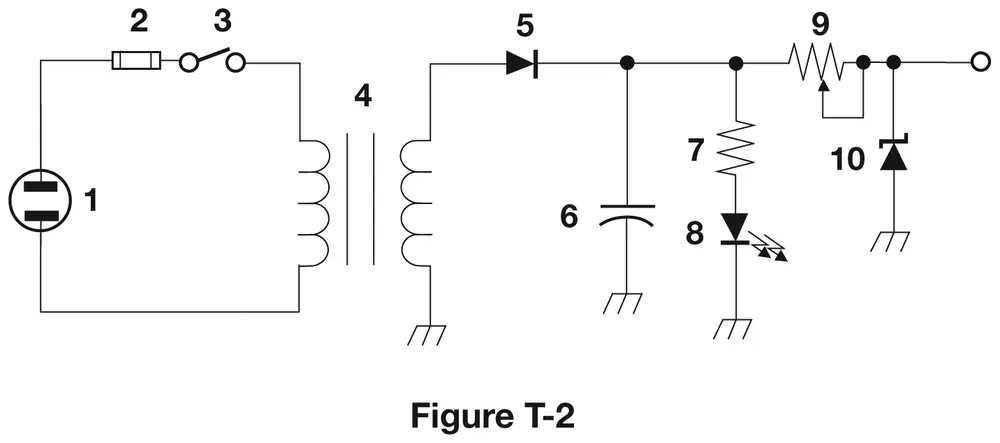
What type of switch is represented by component 3 in figure T-2?
Figure T-2
A Single-pole single-throw
B Single-pole double-throw
C Double-pole single-throw
D Double-pole double-throw
Show the answer and explanation
Correct answer: A. Single-pole single-throw
Why A is right. A. Single-pole single-throw.
Component 3 in figure T-2 is drawn as two small open circles with a short line tilted up from one of them, like a gate left open. It has one moving contact and one place to connect, so it can only turn one circuit on or off.
Why not B? A double-throw switch would show a second contact for the arm to swing to.
T6A10
Which of the following battery chemistries is rechargeable?
A Nickel-metal hydride
B Lithium-ion
C Lead-acid
D All these choices are correct
Show the answer and explanation
Correct answer: D. All these choices are correct
Why D is right. D. All these choices are correct.
Nickel-metal hydride cells power many handheld radios, lithium-ion packs fill phones and newer radios, and lead-acid batteries run cars and backup station power. All three can be charged again and used many times.
T6A11
Which of the following battery chemistries is not rechargeable?
A Nickel-cadmium
B Carbon-zinc
C Lead-acid
D Lithium-ion
Show the answer and explanation
Correct answer: B. Carbon-zinc
Why B is right. B. Carbon-zinc.
Carbon-zinc cells are cheap, single-use batteries. Their chemical reaction cannot be safely reversed, so you throw them away when they run down. Trying to charge them can make them leak or burst.
Why not C? Lead-acid batteries, like car batteries, are recharged all the time.