Not affiliated with or endorsed by the FCC, NCVEC, ARRL or any VEC. Questions are the NCVEC pools word for word (public domain); explanations are our own. Exam rules and fees can change: check with your VE team.
Group T6D of the Technician pool (2026–2030) has 11 active questions. One of them is on every Technician exam. Each is shown word for word; open it to see the correct answer and our explanation.
T6D01
Which of the following devices or circuits changes an alternating current into a varying direct current signal?
A Transformer
B Rectifier
C Amplifier
D Reflector
Show the answer and explanation
Correct answer: B. Rectifier
Why B is right. B. Rectifier.
A rectifier uses diodes to let current pass in only one direction. AC swings both ways, so the output becomes pulses that go one way only. That is DC that still varies, which a filter later smooths.
Why not A? A transformer changes AC voltage but the output is still AC.
T6D02
What is a relay?
A An electrically-controlled switch
B A current-controlled amplifier
C An inverting amplifier
D A pass transistor
Show the answer and explanation
Correct answer: A. An electrically-controlled switch
Why A is right. A. An electrically-controlled switch.
A relay has a coil and a set of switch contacts. Current through the coil makes a magnetic pull that moves the contacts. A small control current can then switch a separate, often larger, circuit.
Why not B? A relay switches on or off; it does not make a signal larger.
T6D03
Which of the following is a reason to use shielded wire?
A To decrease the resistance of DC power connections
B To increase the current carrying capability of the wire
C To prevent coupling of unwanted signals to or from the wire
D To reduce receiver overload
Show the answer and explanation
Correct answer: C. To prevent coupling of unwanted signals to or from the wire
Why C is right. C. To prevent coupling of unwanted signals to or from the wire.
Shielded wire wraps the inner conductor in a metal braid or foil, usually connected to ground. The shield keeps outside signals from getting onto the wire and keeps the wire's own signal from leaking out.
Why not A? Resistance depends on the inner conductor, and a shield does not lower it.
T6D04
Which of the following displays an electrical quantity as a numeric value?
A Potentiometer
B Transistor
C Meter
D Relay
Show the answer and explanation
Correct answer: C. Meter
Why C is right. C. Meter.
A meter measures an electrical quantity, such as voltage, current or resistance, and shows the result. A digital meter shows it as numbers on a display.
Why not A? A potentiometer adjusts resistance; it does not measure or display anything.
T6D05
What type of circuit controls the amount of voltage from a power supply?
A Regulator
B Oscillator
C Filter
D Phase inverter
Show the answer and explanation
Correct answer: A. Regulator
Why A is right. A. Regulator.
A voltage regulator holds a power supply's output steady at a set voltage, even when the load or the input changes. Radios work best on steady voltage.
Why not B? An oscillator makes a repeating signal; it does not set supply voltage.
T6D06
What component changes 120 V AC power to a lower AC voltage for other uses?
A Variable capacitor
B Transformer
C Transistor
D Diode
Show the answer and explanation
Correct answer: B. Transformer
Why B is right. B. Transformer.
A transformer has two windings sharing a magnetic core. AC in one winding makes AC in the other. With fewer turns on the output winding, the output voltage is lower, so 120 V AC can become a safer, lower AC voltage.
Why not D? A diode turns AC into pulsing DC; it does not step the voltage down.
T6D07
Which of the following is commonly used as a visual indicator?
A LED
B FET
C Zener diode
D All these choices are correct
Show the answer and explanation
Correct answer: A. LED
Why A is right. A. LED.
An LED is a diode that gives off light when current flows forward through it. It is small, uses little power and lasts a long time, so it is used for on-air, power and status lights.
Why not B? A FET is a transistor that controls current and gives off no light.
T6D08
Which of the following is combined with an inductor to make a resonant circuit?
A Resistor
B Zener diode
C Potentiometer
D Capacitor
Show the answer and explanation
Correct answer: D. Capacitor
Why D is right. D. Capacitor.
An inductor stores energy in a magnetic field and a capacitor stores it in an electric field. Connected together, energy swings back and forth between them. This happens most strongly at one frequency, which is resonance.
Why not A? A resistor only turns energy into heat; it stores nothing to swap back and forth.
T6D09
What is the name of a device that combines several semiconductors and other components into one package?
A Transducer
B Multi-pole relay
C Integrated circuit
D Transformer
Show the answer and explanation
Correct answer: C. Integrated circuit
Why C is right. C. Integrated circuit.
An integrated circuit, or IC, puts many transistors, diodes, resistors and other parts on one small chip of semiconductor inside a single package. A whole amplifier or regulator can fit in one IC.
Why not B? A relay is a coil-driven switch, not a package of semiconductors.
T6D10
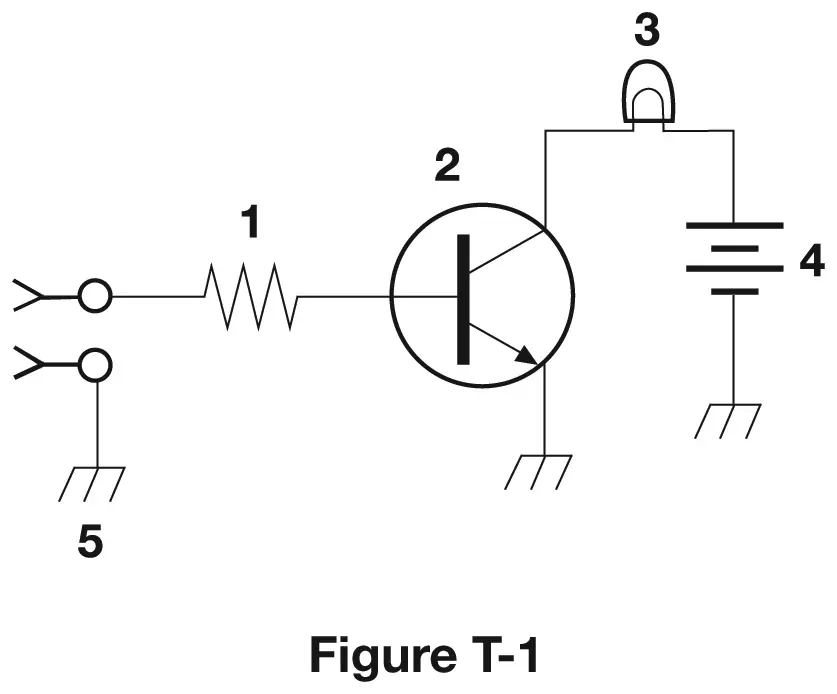
What is the function of component 2 in figure T-1?
Figure T-1
A Give off light when current flows through it
B Supply electrical energy
C Control the flow of current
D Convert electrical energy into radio waves
Show the answer and explanation
Correct answer: C. Control the flow of current
Why C is right. C. Control the flow of current.
Component 2 in figure T-1 is the transistor, a circle with a bar and two slanted lines, one with an arrow. A small current through resistor 1 into its base lets a larger current flow from battery 4 through lamp 3. The transistor turns the lamp on and off.
Why not A? Giving off light is the job of the lamp, component 3.
T6D11
Which of the following is a resonant or tuned circuit?
A An inductor and a capacitor in series or parallel
B A linear voltage regulator
C A resistor circuit used for reducing standing wave ratio
D A circuit designed to provide high-fidelity audio
Show the answer and explanation
Correct answer: A. An inductor and a capacitor in series or parallel
Why A is right. A. An inductor and a capacitor in series or parallel.
An inductor and a capacitor trade stored energy back and forth. At one frequency their effects balance, and the circuit responds most strongly there. Changing either part changes that tuned frequency.
Why not C? Resistors alone do not resonate; they only turn energy into heat.